

Download the Case Study
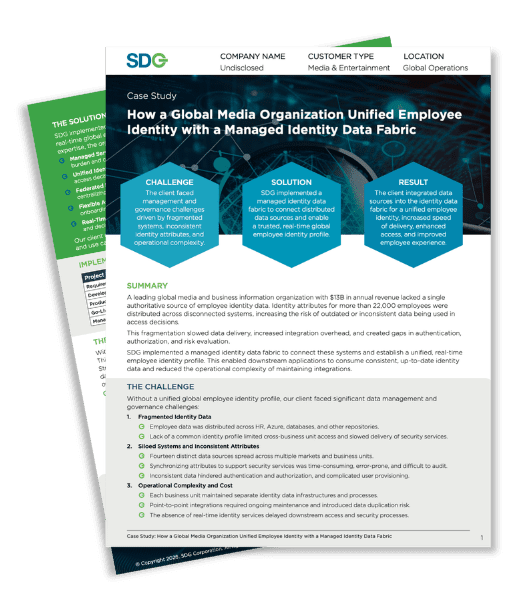
A leading global media and business information organization with $13B in annual revenue lacked a single authoritative source of employee identity data. Identity attributes for more than 22,000 employees were distributed across disconnected systems, increasing the risk of outdated or inconsistent data being used in access decisions.
This fragmentation slowed data delivery, increased integration overhead, and created gaps in authentication, authorization, and risk evaluation.
SDG implemented a managed identity data fabric to connect these systems and establish a unified, real-time employee identity profile. This enabled downstream applications to consume consistent, up-to-date identity data and reduced the operational complexity of maintaining integrations.
The Challenge
Without a unified global employee identity profile, our client faced significant data management and governance challenges:
1. Fragmented Identity Data
- Employee data was distributed across HR, Azure, databases, and other repositories.
- Lack of a common identity profile limited cross-business unit access and slowed delivery of security services.
2. Siloed Systems and Inconsistent Attributes
- Fourteen distinct data sources spread across multiple markets and business units.
- Synchronizing attributes to support security services was time-consuming, error-prone, and difficult to audit.
- Inconsistent data hindered authentication and authorization, and complicated user provisioning.
3. Operational Complexity and Cost
- Each business unit maintained separate identity data infrastructures and processes.
- Point-to-point integrations required ongoing maintenance and introduced data duplication risk.
- The absence of real-time identity services delayed downstream access and security processes.
The Solution: Managed Identity Data Fabric
SDG implemented a managed identity data fabric to connect distributed data sources and enable a trusted, real-time global employee identity profile. By leveraging SDG specialists for architecture, design, and delivery expertise, the organization accelerated time-to-value. Key benefits include:
- Managed Service Delivery: SDG delivered and operated the solution with 24×7 support, reducing internal operational burden and cost.
- Unified Identity Profiles: Consolidated employee identities into a single global profile to support consistent access decisions.
- Federated Data Fabric: Provided a federated view across HR, Azure, and database systems without physically centralizing all identity data.
- Flexible Architecture: Enabled secure real-time access with intelligent caching (millisecond response) and rapid onboarding of new identity sources.
- Real-Time Identity Visibility: Enabled teams to access and use current identity attributes to support security controls and decision-making.
Our client established a foundation for expanding access to trusted identity data across additional systems and use cases.
| Project Phase | Duration | Key Activities |
|---|---|---|
| Requirements Definition & Design | 3 weeks | Identify identity sources, define object types, user and group object schema |
| Development Integration & Build | 14 weeks | Connected fourteen distinct data sources across multiple markets and business units |
| Production Integration & Build | 3 weeks | Document and deliver the production infrastructure, integrations, and user management |
| Go-Live & Post-Production Support | 2 weeks | Enable real-time access for security and identity systems |
| Management of Deployed Solution | Ongoing | Support and enhancements to the deployed architecture |
The Results
With the base solution deployed, the client integrated data sources into the identity data fabric within hours. This enabled direct access to identity data by authentication, authorization, and identity management services. Streamlining the single sign-on (SSO) experience improved consistency for end users. Automated daily identity data processing helped reduce manual effort while improving data accuracy and quality — reducing operational overhead and improving data accuracy. By leveraging an identity data fabric, our client achieved:
- Unified Employee Identity: All business units access a single, trusted employee profile for enhanced security services in near real time.
- Speed of Delivery: New identities can be incorporated into the identity fabric without requiring data synchronization.
- Enhanced Access: Applications can leverage consistent identity data for access, user management, and extended profile attributes.
- Better Employee Experience: Consolidating profiles enabled a unified authentication and authorization flow aligned with security controls.
The organization now views the managed identity data fabric as a strategic enabler for future growth and delivery of identity-driven solutions.